

Switching Training: Teaching the FND Brain to Become Less ‘Sticky’
Something I’ve been doing increasingly with some of my FND clients, and more recently with some of my complex musculoskeletal rehabbers, is a strategy I’ve termed “switching training.”
The idea came from reading research suggesting that FND may involve difficulty flexibly transitioning between different brain states and neural networks as the demands of the environment change. Rather than the problem simply being that a particular neural network is overactive or underactive - the nervous system may become less flexible in how it moves between different functional states. The language I use with my clients is that the brain can become “sticky.”
The brain is constantly switching states
One network particularly relevant to this idea is the salience network. Here, salience means importance, and this network, which includes regions such as the anterior insula and dorsal anterior cingulate cortex, helps determine which information deserves our attention at any point in time. This might be something happening externally to us, a sensation within the body, an emotional stimulus or something important to the task we are performing.
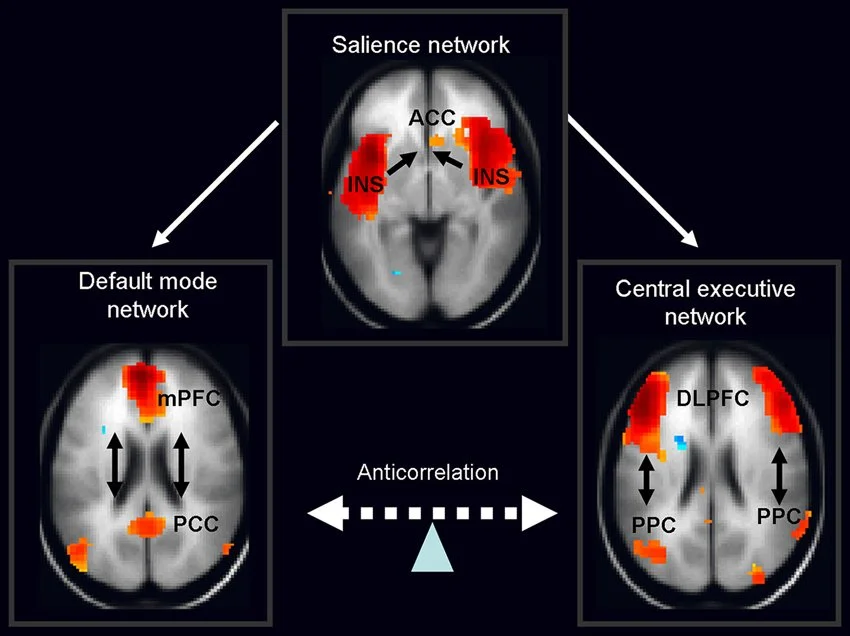
The salience network also appears to play an important role in coordinating transitions between other large-scale networks, particularly the default mode network (DMN) and central executive network (CEN). Broadly speaking, the DMN is more strongly associated with internally directed processes such as self-referential thought and mind-wandering, whereas executive networks become increasingly engaged when attention needs to be directed towards an external task.
Importantly, these aren't simple on/off switches, and the networks interact dynamically rather than operating in isolation. But the general principle is useful: a healthy nervous system needs to be able to transition flexibly between different brain states depending on what life demands.
There is growing evidence that this flexibility may be altered in FND. Salience-network abnormalities have repeatedly been identified, alongside altered interactions between networks involved in attention, sensorimotor processing, emotion, interoception and agency. More recently, research examining dynamic connectivity has found that people with motor FND can spend different amounts of time in particular brain-network states, with some findings suggesting reduced flexibility in switching between them.
Internal versus external attention
Many people with FND become highly aware of what is happening inside their body. Movement becomes something that needs to be consciously monitored. Sensations that most people would barely notice can become extremely salient, and actions that would ordinarily occur automatically can begin to require significant conscious attention.
Interoception - the processing and perception of signals originating from within the body - is increasingly being implicated in FND. Recent neuroimaging research has demonstrated altered processing during interoceptive attention in regions including the anterior insula and anterior cingulate cortex, both of which are closely associated with salience processing and the integration of bodily information.
However, the picture is more complicated than simply saying that people with FND have “too much interoception”. Some studies have actually demonstrated reduced interoceptive accuracy or reduced neural responses to particular internal signals. What appears more consistent is that the relationship between bodily signals, attention and their perceived significance seem to be altered.
Clinically, this can look like a nervous system that finds it difficult to disengage from internal self-monitoring and transition towards the externally focused, automatic control required for fluid movement. This is one reason why externally focused rehabilitation can be so effective in FND. Rather than asking someone to concentrate on their leg, their muscle contraction or exactly how they are moving, we can give the nervous system an external problem to solve: hit a target, follow a rhythm, catch a ball, respond to a light, step over an object or move to music. Movement becomes the means of achieving the goal rather than the object of attention itself.
From external focus to switching training
As a result, current FND physiotherapy rightly places considerable emphasis on reducing excessive self-focused attention and encouraging more automatic, externally directed movement. For many of my clients, that is exactly where I start. But if part of the underlying problem is reduced flexibility between brain states, then continually keeping someone externally focused may help them access a better movement, without necessarily training their ability to produce that movement flexibly across different contexts. This led me to start deliberately alternating tasks requiring different attentional demands during my sessions.
For example, I might begin with a task involving a strong internal sensory focus: breathing, noticing a particular bodily sensation or attending to the sensory input produced by electrical stimulation. I will then have them transition directly into something externally focused, such as reacting to BlazePods, walking to a metronome, playing an electronic drum kit or solving a movement problem in the environment. Then we might switch back again.
The goal isn't to decide that internal attention is bad and external attention is good. The goal is flexibility. Can the nervous system move into an internally focused state when that state is useful, and then efficiently disengage from it when the environment demands something else? In other words, can we make the system less sticky?
What I've noticed clinically
Interestingly, some of my FND clients initially find these transitions surprisingly difficult. In particular, I've noticed that moving from an internally focused task directly into an externally focused movement task can sometimes produce a temporary deterioration in movement or symptoms. After repeated exposure, however, that transition can become easier.
Of course that is a clinical observation, not evidence that I am directly retraining salience-network switching and we cannot infer changes in brain-network dynamics simply because someone becomes better at switching between two rehabilitation tasks. But it raises an interesting hypothesis:
Could attentional switching itself be something worth training in FND?
Rather than only finding the attentional state in which somebody moves best, perhaps rehabilitation could progressively improve their ability to move between different states while maintaining functional movement.
I see something similar in complex MSK rehabilitation
Interestingly, I've begun noticing the same phenomenon in some complex musculoskeletal cases. For example, after ACL injury or reconstruction, I might ask somebody to perform an externally focused cognitive task such as the Stroop Test, and then immediately switch to an internally focused quadriceps contraction where they attend closely to the sensation and force of the muscle. The result? Many of my clients dealing with chronic pain and movement dysfunction seem to also struggle with this transitioning between neural networks.
This is particularly interesting because research increasingly demonstrates that ACL injury is associated with changes extending beyond the knee into the central nervous system. Recent fMRI work has even shown that simply changing the attentional instructions during quadriceps contractions from an internal to an external focus changes patterns of brain activity and network connectivity after ACL reconstruction.
Again, I don't think this means FND and ACL injury are the same problem. They clearly aren't. But both may demonstrate a broader principle that is important within Geometry-Informed Rehab: good movement requires the nervous system not only to access useful neural states, but to transition flexibly between them as task demands change.
A Geometry-Informed Rehab perspective
This is where switching training fits into GIR. I have previously written about rehabilitation as an attempt to expand the repertoire of stable, adaptable neural trajectories available to the nervous system. From that perspective, it isn't enough for somebody to discover one neural state in which movement works well. They need flexibility.
A person may walk beautifully while following a metronome but struggle without it. They may move well while catching a ball but deteriorate as soon as their attention returns to their body. They may perform perfectly in the clinic but lose that movement when they become anxious, fatigued or overwhelmed by bodily sensations or external stimulus.
Finding the state in which movement works is therefore only the beginning. The longer-term goal is to make functional movement robust across states. My current hypothesis is that switching training may contribute to this by deliberately exposing the nervous system to transitions between different attentional and sensory demands, while repeatedly asking it to maintain or recover successful movement.
This differs slightly from simply using external focus throughout rehabilitation. External focus can provide an incredibly useful entry point into better movement, particularly when internal self-monitoring is interfering with automatic motor control such as in FND. But ultimately, life doesn't allow us to remain externally focused all the time. We experience pain. We notice our heartbeat. We become anxious. We get tired. We think about our bodies. Then something in the environment demands our attention and the nervous system has to reorganise again.
The opposite is may also true: if movement can only be achieved with high levels of internal self-monitoring, what happens to that movement when the environment around us demands our attention, such as playing a sport or walking down a busy high street?
For me, successful FND rehabilitation shouldn't require someone to avoid those internal states forever. It should progressively build a nervous system that can enter them, leave them and continue to move effectively despite them. That is what I mean by switching training. And while the mechanism remains hypothetical, emerging research showing altered dynamic brain-state switching in FND makes it an idea I think is increasingly worth exploring.
Key References
Goulden N, Khusnulina A, Davis NJ, et al. (2014). The salience network is responsible for switching between the default mode network and the central executive network: replication from DCM. NeuroImage, 99, 180–190.
Perez DL, Nicholson TR, Asadi-Pooya AA, et al. (2021). A framework for understanding the pathophysiology of functional neurological disorder. CNS Spectrums.
Altered brain network dynamics in motor functional neurological disorders: the role of the right temporo-parietal junction. (2025). Study demonstrating altered dynamic network states in motor FND, including findings interpreted as potentially reflecting impaired flexibility in brain-state switching.
Altered Neural Processing of Interoception in Patients With Functional Neurological Disorder: A Task-Based fMRI Study. (2025). Study demonstrating altered cingulo-insular responses during interoceptive attention in FND.
Focus of Attention Impacts Brain Activity and Connectivity Early After Anterior Cruciate Ligament Reconstruction. (2026). fMRI study demonstrating different neural activity and connectivity during internally versus externally focused quadriceps contractions after ACL reconstruction.